
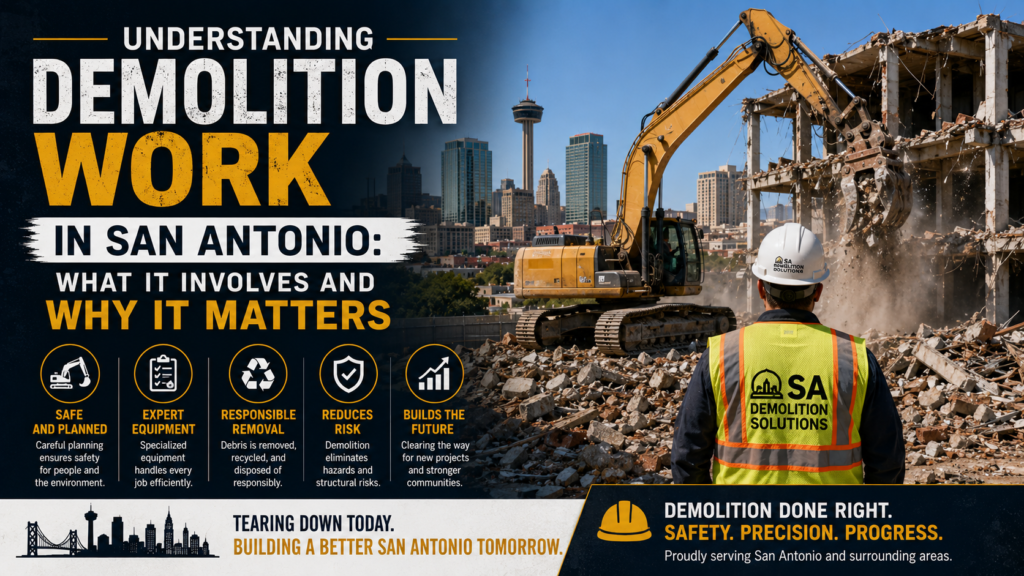
Demolition is one of the most physically dramatic phases of any construction or redevelopment project. Within hours or days, structures that took months to build can be systematically reduced to rubble and cleared from a site. But behind that apparent speed lies a sophisticated planning process, specialized equipment, strict regulatory compliance, and a level of skill that separates professional Demolition Contractor San Antonio from those who simply operate heavy machinery.
For property owners, developers, and builders in San Antonio planning to remove structures whether a single interior wall or an entire commercial building understanding what professional demolition involves is the foundation of making good decisions about how to proceed.
What Demolition Actually Encompasses
Demolition is the controlled removal of structures or portions of structures. The word ‘controlled’ is the key differentiator between professional demolition and unmanaged destruction. A professional demolition contractor in San Antonio plans every aspect of a removal the sequence in which structural elements come down, how adjacent structures or utilities are protected, where debris is staged for removal, and how materials are sorted for disposal or recycling.
Demolition is a distinct skilled trade. Crews must understand how buildings are constructed to determine how they should safely come apart. A structure that is torn down in the wrong sequence can become dangerously unstable before intended, endangering workers, bystanders, and adjacent property. Recognizing load-bearing elements, understanding how structural forces redistribute as supports are removed, and knowing when mechanical equipment versus manual techniques are appropriate are all trade knowledge that experienced demolition professionals carry.
Types of Demolition Services
The demolition industry encompasses several distinct service types, each suited to different project needs. Understanding which type applies to your project is the starting point for scoping the work correctly.
Full structure demolition is the complete removal of an entire building from roof to foundation. This is the most resource-intensive form of demolition, typically requiring large tracked excavators with specialized attachments, substantial debris hauling capacity, and careful coordination of utility disconnections before work begins. Full demolition is common on redevelopment sites where existing buildings have reached the end of their useful life or are incompatible with new development plans.
Selective demolition, sometimes called interior demolition or soft demolition, involves the removal of specific elements within an existing structure while preserving the rest. This is common in renovation projects where walls, floors, fixtures, or systems are being removed to enable a redesign. Selective demolition requires particularly precise technique to avoid damaging elements that will remain. Workers may use hand tools, small power tools, and compact machinery rather than large excavators, working carefully within tight spaces.
Concrete and slab removal is a frequent standalone service in San Antonio. Driveways, parking lots, warehouse floors, and foundations that need to be removed to prepare a site for new construction require specialized equipment typically hydraulic breakers and excavators to fracture and remove reinforced concrete efficiently. San Antonio’s significant base of older commercial and industrial properties means this service is in consistent demand.
Pool demolition addresses the specific challenge of removing below-grade concrete pools. The two main approaches are partial removal, where the pool is broken up and collapsed in place with material added to fill and compact the void, and complete removal, where all concrete is excavated and hauled away. The appropriate method depends on factors including future use of the site, local code requirements, and soil conditions.
Emergency demolition responds to structures that have been rendered unsafe by fire, flood, vehicle impact, or structural failure. These situations require rapid response often within hours and the ability to work safely around compromised structural conditions. Emergency demolition is a specialized capability not all contractors are equipped to provide.
The Pre-Demolition Process
A professional demolition contractor in San Antonio does significant work before a single piece of equipment arrives on site. This pre-demolition process is essential to safe, compliant, and efficient execution.
Utility disconnection is the first priority. All gas, electric, water, sewer, and telecommunications connections to a structure must be properly disconnected and capped before demolition begins. Failing to disconnect utilities creates severe hazards a gas line struck during demolition can cause fires or explosions; an energized electrical service creates electrocution risk. Professional contractors coordinate these disconnections with the relevant utility companies as part of their pre-demolition checklist.
Hazardous material assessment and abatement is legally required in most meaningful demolition work. Asbestos-containing materials were commonly used in building construction in the United States through the 1970s and, in some applications, into the 1980s. Lead-based paint was common in residential construction before 1978. Buildings of these vintage eras require a hazardous materials survey before demolition, and any regulated materials must be abated by licensed specialists before general demolition can proceed. This is not optional it is a legal requirement enforced at the state and federal levels.
Permitting is required for demolition work in San Antonio. The City’s Development Services Department reviews demolition permit applications to ensure proper utility disconnections are documented and that neighboring properties will be protected. Responsible contractors handle the permit application as a routine part of project initiation, not as an afterthought.
Demolition and Debris Management in San Antonio
The debris generated by demolition concrete, wood, metal, drywall, roofing materials, and more must be properly managed. Professional demolition contractors in San Antonio sort materials on site to maximize recycling and minimize what goes to landfill. Concrete is typically crushed and recycled as aggregate. Metals are sorted and sent to recycling facilities. Clean wood may be reused or chipped. Only materials that cannot be recycled or repurposed go to permitted disposal facilities.
This attention to material sorting is not just environmentally responsible in some cases it is legally required, and in others it reduces overall project costs by generating revenue from recyclable materials or reducing tipping fees. Contractors with established relationships with recycling facilities and aggregate processors in the San Antonio area can handle this process efficiently.
Demolition Safety
Safety is the most non-negotiable element of demolition work. The hazards involved falling debris, equipment strikes, structural collapse, hazardous materials, utility strikes are serious and can be fatal. Professional demolition contractors operate under detailed safety plans specific to each project, providing proper personal protective equipment to all workers, establishing exclusion zones to keep unauthorized personnel away from the work area, and following OSHA regulations governing demolition operations.
When evaluating a demolition contractor in San Antonio, asking about safety record, OSHA compliance, and the specific safety plan for your project is not a peripheral concern. It is a central indicator of the professionalism and reliability of the operation.
Conclusion
Demolition in San Antonio is a complex, regulated, safety-critical trade that requires specialized knowledge, appropriate equipment, and meticulous planning. Whether you are clearing a site for new construction, renovating an existing structure, or responding to an emergency, working with a professional demolition contractor is the responsible path forward. The work that comes next whatever form the new development takes begins with a clean, properly prepared site, and getting there is what skilled demolition professionals do.